Nature & Style
A lichen palette: take the colour, leave the living surface
Read a tiny landscape without collecting it, then turn grey, dark brown and a small flash of ochre into a considered winter outfit.
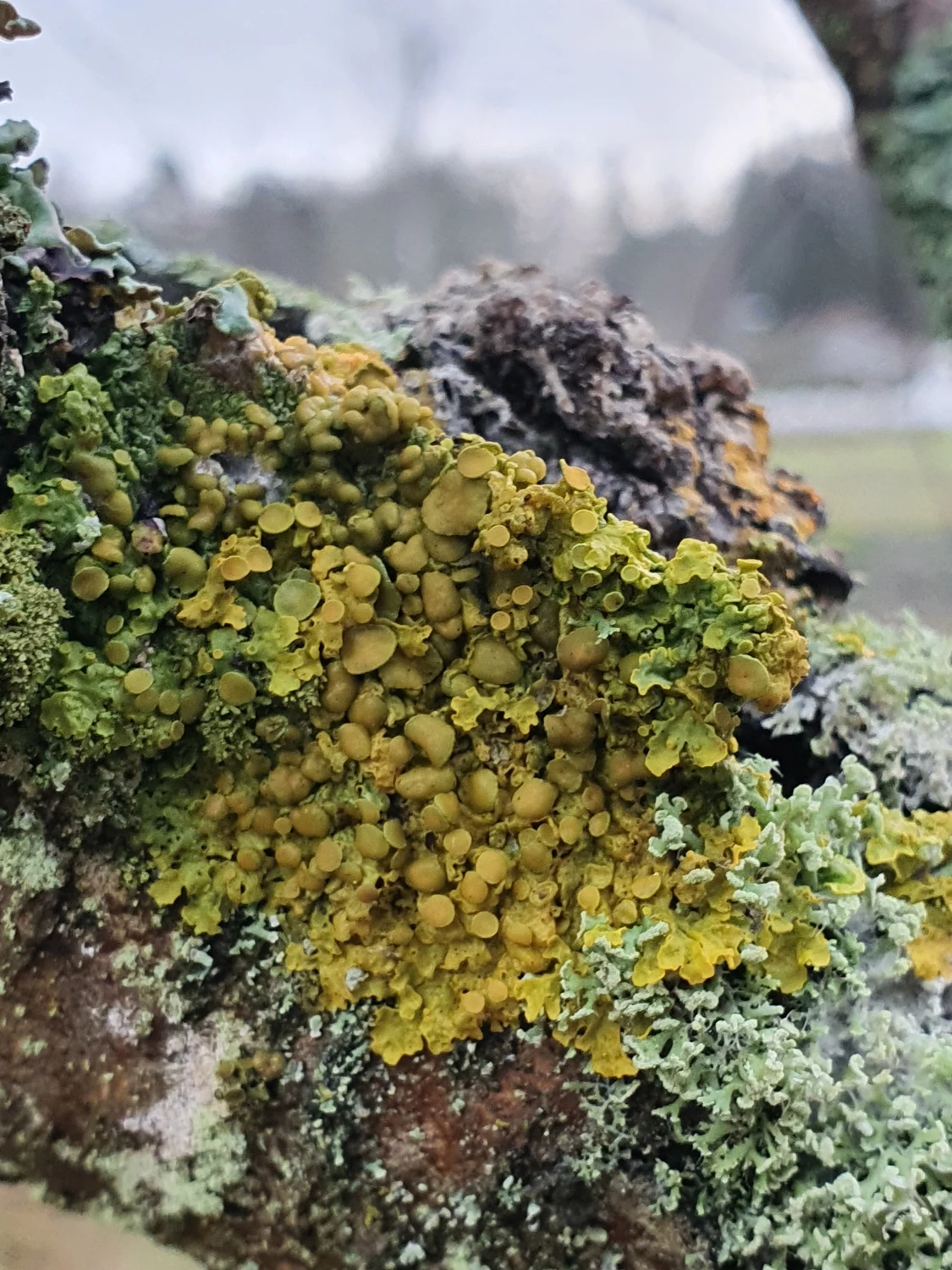
The most interesting colour on a winter walk may be a patch smaller than your palm. Against rough bark, ochre-yellow lichen looks almost like embroidery already attached to a dark coat. The useful lesson is not to take it home. It is to look closely enough to separate background, texture and accent—and bring that observation into clothes you already own. This is an original visual exercise, not a report of a field visit.
Begin with a partnership, not a plant label
Lichens are not simply miniature mosses. The US Forest Service describes them as associations whose main partners include a fungus and one or more photosynthetic organisms, which may be algae or cyanobacteria. Other organisms can also be part of these communities. That complexity is a better starting point than treating every coloured patch on a tree as the same thing.
The real photograph here is catalogued as Xanthoria parietina and was made by Jens Ullenius, known as jensu, on 25 November 2020. Its visible ochre-yellow lobes and small cup-like shapes are the subject of our colour reading. The captioned identification belongs to that documented image; it does not identify a similar patch you might encounter elsewhere.
Three shapes to notice, without making a species verdict
The British Lichen Society distinguishes, among other forms, crustose lichens that grow as a thin attached crust, foliose lichens with flattened leaf-like lobes, and fruticose forms that look shrubby. These are growth-form words, not a complete identification key. Use them to describe what you see more carefully rather than to declare a species from a phone photograph.
Try a three-line note: what surface it grows on; whether the outline appears flat, lobed or branching; and which colour occupies the least space. If you cannot decide, write that uncertainty down. A useful observation can be honest and unfinished. Do not scrape or detach anything to improve the description.
Build the outfit from proportions, not exact colour matching
Our editorial proposal uses the photograph as a compositional prompt: a dark foundation, a quieter middle tone and one small warm accent. Imagine black trousers, a charcoal knit and a compact ochre scarf. The scarf does not need to reproduce the organism’s precise colour; light, screens and fabric surfaces all change how a colour appears.
Start with pieces already in the wardrobe. Lay them together in daylight and look from a little distance. If each item is competing, make one quieter before buying another. A smooth trouser with a softly textured knit can echo contrast without imitating bark literally. This is a styling preference, not a claim that nature supplies universally flattering colours.
An original example: a short walk followed by lunch
Consider a reader who wants to walk in an accessible park, then meet a friend indoors. Her proposed outfit is familiar flat shoes, comfortable dark trousers, an opaque knit and a removable outer layer. A small warm-coloured accessory supplies the accent. She tests sitting, her usual walking stride and carrying the removed coat before leaving. This is a hypothetical example, not a tested product recommendation.
Makeup can stay equally edited: one familiar lip colour or a softly defined eye, according to personal preference. We are borrowing a relationship between colours, not recommending lichen ingredients, extracts or homemade cosmetics. The field observation is not a beauty treatment, and no skin benefit is claimed.
Keep the observation where it belongs
The British Lichen Society’s conservation guidance asks people to leave lichens alone and explains the pressures associated with collection and habitat damage. For this exercise, photographs and notes are enough. Stay on permitted routes, follow local access rules and avoid touching, peeling, wetting or rearranging the surface for a better picture. The same restraint applies to a fallen twig.
Do not infer clean air, the age of a tree or the health of a whole habitat from one colourful patch. The Forest Service uses lichen communities in structured environmental monitoring; a casual glance is not that method. A decorative observation should not be promoted into a scientific diagnosis. Keep the pleasure of looking separate from conclusions the evidence cannot support.
A five-box palette card for the next outing
Make a small card with five boxes: background colour; secondary colour; smallest accent; texture contrast; one outfit from existing pieces. In the final box, add a question rather than a shopping list: would a smaller accent work better, or would a smoother layer make the outfit calmer? Write the place and date separately so your note remains a record of one encounter.
At home, compare the idea in ordinary light and while moving. Remove the accent once and see whether you miss it. If a purchase still feels useful, define its job first—perhaps a compact notebook for observations rather than another garment. The most valuable result may be a new way to use an old scarf, with the living landscape entirely intact.
A considered wardrobe can begin with attention rather than acquisition. Bring back a proportion, a question and a photograph; let the lichen keep the bark.